
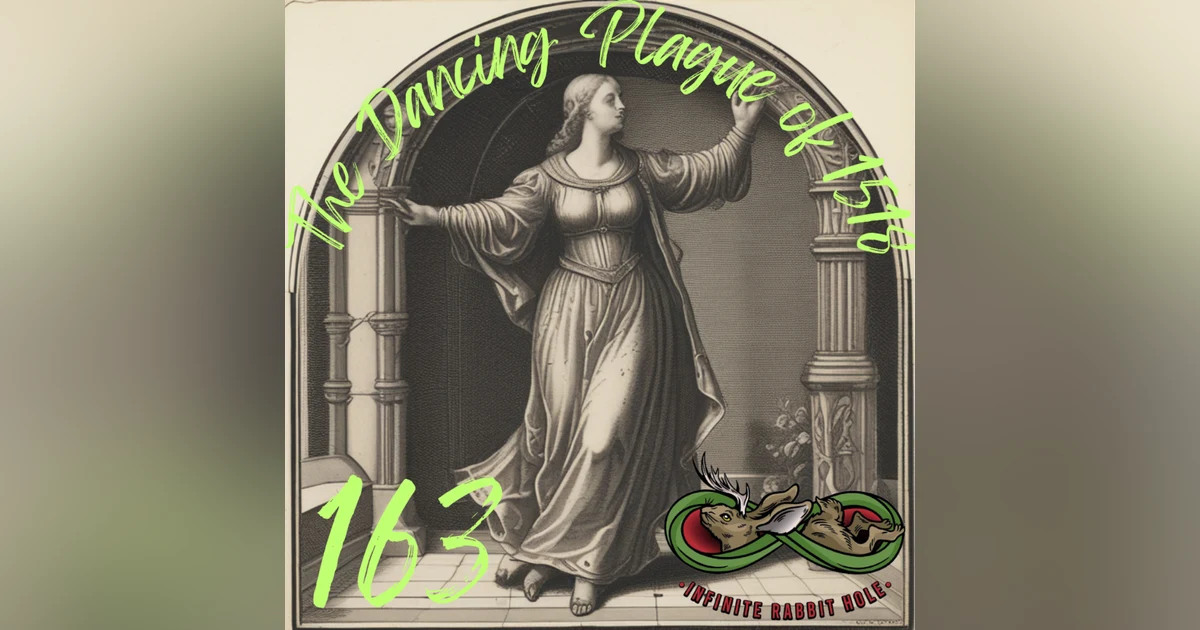
163. The Dancing Plague of 1518


 Apple Podcasts

 Spotify

 Castro

 RSS Feed

 Amazon Music

 iHeartRadio

 Audible

 YouTube

 Pandora

 PocketCasts

 Castbox

 RadioPublic
In July of 1518 a woman from Alsace (a historic region of the Holy Roman Empire, in modern north eastern France) stepped out into the streets and began a contagious dance that caused over 400 others to join and many to die. Today we dive into the incredible historical phenomenon known as the Dancing Plague of 1518. Welcome back to Infinite Rabbit Hole!
--- Support this podcast: https://podcasters.spotify.com/pod/show/infiniterabbithole/support
0:14 In the summer of 1518, the town of Strasbourg, Alsace, or modern day France, was engulfed in one of, if not the strangest phenomena that has ever been recorded throughout human history. It began when a woman by the name of Frau Truffea left her home and began to dance in the street. As her husband and neighbors attempted to figure out exactly what she was doing, they were met with only more dancing. She danced throughout the day and well into the night, and then she collapsed. Frau Truffea had fallen asleep from pure exhaustion due to simply not being able to stop dancing.
0:55 The severity of this event became apparent when the next day Trophia rose up and continued her dance with sore muscles, joints, and feet. The townsfolk looked on as a tearful Trovea again danced the entirety of the day and night, only to collapse again at the point of pure exhaustion caused by her energy simply ending for Al. Truphia laid in the street, feet bloodied and brewed and rested for hours As she awoke. The dance continued, blood began soaking her shoes and tears ran down her face as her body moved without command. The pain of her muscle aches caused by the last 48 plus hours of dancing was unbearable.
1:40 More and more people gathered and began to talk amongst themselves, and to many she had been possessed by a demon for her sins, and to some she was a gift directly from God. But over the next few days, up to 50 more people would be added to this mix of fanatical dancing, and everyone found themselves terrified that they would be next to be trapped in the never ending movements that were causing people to dance so much that the bones in their feet were exposed to the bare grounds of the streets. By the time it was over, a minimum of 400 people had joined the dance, many of whom to their death. Today we look into one of the biggest medical mysteries in the history of humankind.
2:23 Today we dive into the dancing play of 1518. Welcome back to Infinite Rabbit. Imagine. This line represents the time present 1985 Future Past prior to this point in time somewhere here in the past. The timeline you've gone into this tangent creating on the Swift 1985 alternate to you need an Einstein reality for everyone else. And welcome back to the Infinite Rabbit Hole podcast. I'm your host, Jeremy.
3:23 Today we're going to go way back in time to a place called Alsace, which was an area that we now refer to as northeastern France, where one of the biggest mysteries in all of human history took place. That, of course, as you know from the title of the episode, is the Dancing Plague of 1518. Now there were dancing plagues prior to 1518 and we'll talk about that a little bit more in the actual episode. Before we jump into that, I just want to remind everybody that if you're in the area of Elmwood, WI on the weekend of July 26th, 27th and 28th, Infinite Rabbit Hole will be making their first ever in person appearance at UFO Days, which is a festival about UFOs in a small town of only about 800 people with plenty of people that have all their own stories of a UFO and alien encounters. And we'll be there to get their stories. So please, if you're in the area, stop on by the booth. And even though we haven't really decided exactly what we're going to talk about there, we will be speaking. We'll be doing live episodes.
4:25 We'll have a great time. So please head on over and check us out. Say hi. We're looking forward to meeting you travelers. And one more thing before we get going on this episode, please rate this podcast. Something as simple as a five star rating helps out immensely. It's free and it would be greatly appreciated by everyone here at the Infinite Rabbit. Without further ado, everybody, here is my presentation on the dancing play of 1518, Joy, The Dance of Frau Trufia.
5:18 The exact date in which Frau Truffia began her dance is up for debate, but we do know that it began about a week prior to July 14th and 1518. This is due to that being the date of the Holy festival dedicated to Mary Magdalene, which came with minor documentation of the dancing, which started roughly a week prior. Nobody has any clue as to what she was doing just prior to being spotted for the first time dancing in the streets, but it has been stated in a few publications that her husband has seemed desperate, tempting to stop her. It began with a bit of anger from what many imagined to be embarrassment, but as the hours ticked away it began to transform into something more of concern.
6:01 Her dance continued that day well into the evening, in front of an ever growing crowd of onlookers. They watched as her movements became sluggish and shortened as she lost energy in the wee hours of the night until she eventually collapsed right where she stood, in the middle of the street. Frau Choufea had fallen asleep at an unknown time. The next day she rose from her sleep and immediately began to dance once more. The crowds came back and everyone began speculating that this was more serious than they had originally believed. At first, the people in the crowd made comments against her dignity, claimed that she was acting inappropriate, and that this was all an act for attention.
6:44 This pattern of sleep and dancing continued for many days in varying reports. Some claimed that her movements were accompanied by her consistent cries and screams throughout the entirety of her dance. Some say that she stopped making any sounds after day three and simply continued to dance, complete silence with a dull expression upon her face until she passed away. And there are the others that claim that the expressionless 1000 yard stare was consistent since the very beginning. But what we do know is that there was blood, bruising, swelling and lacerations on and around her feet and ankles, as well as many tears in her eyes. And thanks to sermon records and notes from the Strasbourg City Council, we can also rest easy knowing that Frau Truffea survived.
7:33 There are no records of what her dance looked like, and very few records of the names of those that would eventually join Frau Truffea in a dance of their own, but speculations arose as to why it happened and the meaning behind it all. The most commonly believed reason behind the dance of the time was that she was possessed by a demon. This stemmed from the ignorant beliefs of the time and the frailty of the female mind and body. The Times believed that women were born sinful and lustful, and due to this they had weaker defenses against possession than men did, which led them being more attractive to demons looking to take over a human's body and mind. So when the opinion evolved shortly after the plague began for Al Trufia was looked at as one of the worst sinful offenders and rumours which were very easily taken as fact.
8:23 Early 1500s began about her being an adulterer, whore and even a thief. Therefore it was believed that she became a direct target of the vengeful St. known as St. Vitus, who was celebrated by a feast that was commonly accompanied with dancing before his statute, which led him to be the patron St. of dancers and entertainers. It was also eventually believed that this dancing plague became a tool of his to cast punishment against those deserving. This was primarily due to the recent plague of syphilis that spread through Strasbourg just prior, which was perceived in the form of punishment to the adulterer, searing sensation in the genitals and easily identifiable sores that announced your sins to the public.
9:11 And it was thought that due to the eventual dancing mania that overtook Strasbourg, St. Vitus had sent the dance as a punishment for not heeding to the first warnings of adultery. So after six entire days of dancing, Frau Tufeyo was forcefully transported about 30 miles West to the Commune Severn where Grotto stood completely dedicated to Saint Vitus, where she was left to dance in shoes of red and a cross on her forehead with many others who had fallen victim to this mysterious dancing plague history. Crazy enough for those that do not consider themselves spiritual or religious. This dance in front of the Shrine of Saint Vitus marked a period where many people ceased to dance, including Frauchefia. So of course this was seen as the answer to their question and further strengthened the belief that this was of the Saints doing now.
10:09 Many of the records of this strange, frantic dancing plague that grasped this town of the once Holy Roman Empire were documented in Latin and High German, but only a handful of original manuscripts survived the explosives used in the Franco Prussian War of 1870. But luckily for us, handwritten copies and old medical texts in various portions of the world were saved that successfully recreated a picture of what took place in the months of July, August, and September of 1518. It was a man who was once considered to be a sorcerer by the name a Theo Frostus von Hohenheim, better known simply as Paracelsus, The Alchemist and physician who would be the first to publish his quote UN quote professional opinion of the strange dance that took so many lives.
11:00 In 1526 he entered the city and was fascinated to hear local preachers reminding their congregations of the penalty cast down upon the sinners a few short years prior. Being a man who openly delved into the lore and literature of the preternatural topics of demons and such, Paracelsus would publish his findings in the 1532 publication Diseases That Rob Men of Their Reason, in which he points to Patient zero for all Trufea as the first of the quote. Whores and scoundrels who were overtaken by irresistible urges to dance to death after she initially began the public display as a way to humiliate her husband, he would go on to name this irresistible urge to dance uncontrollably Horrea lesquiva and those who fell victim Horreomaniacs.
11:52 Prior to the events of 1518 in Strasbourg, there are or were records of other events in history of people randomly breaking out in this dance to the death. In the years prior, areas of Germany and northeastern France also recorded this phenomenon. They were described to be considered a mania, which defined means that these events were stemmed from the uncontrollable passion or mental disorder of the victims. In the book The Dancing Play by John Waller, he describes that there is evidence of up to seven different cases prior to the incident in Strasburg that included more than a single person or family, with the earliest being from a Saxon town called Colbeck in 1017, followed by the next recorded incident in the Germantown of Erfurt in 1247, where the dancing plague affected 100 or more of the town's children. Unfortunately, many of them died, but a handful of them did survive, but were stricken with tremors and fatigue for the rest of their lives.
12:53 The largest account of the dancing plague in history took place in 1374 and began in the area of France known as Rhineland. This case included thousands of people in an area that eventually expanded N to Ghent and to the South to Metz, a stretch that measures about 210 miles from north to South. In this instance, many were able to regain control of their body before dying, that is, for the first time In this case, people commonly relapse back into their dancing frenzy after successfully recovering, in which most died during their second bout, with many catching the plague of dancing 3 or even 4 times. Other than the handful of outbreaks in this vaguely recorded history, there is a large number of cases involving one person or a household of people.
13:42 So why are we talking about the 1518 Strasburg outbreak rather than any of the others? Well, the answer is easy. The events in Strasburg took place after the invention of the printing press in 1440 by Johannes Gutenberg, in an area that was well into the age of bureaucracy in the well documented Roman Empire. This made the event in Strasbourg the best record of the mystery that is the dancing play, while the others are only known to have happened due to bits and pieces of handwritten records, with most supporting information about the cases being lost at times or never being recorded properly at all. A modern answer for a medieval mystery The most understandably common question in regard to the mystery of the dancing plague is of course, how did it happen?
14:32 And for this section and answer to this question, my research primarily came from the book The Dancing Play by John Walder in which he claims that the most commonly accepted reason why people took to the streets to dance to their death is the mold that is common on the stalks of rot known as Irgit, which has been found to have up to 70 different alkaloids, one of which being lacergic acid which is the L&S in LSD. Rye was and is still a very common grain flour which is the base for many breads and beers according to medicalnewstoday.com. When consumed, ergot can induce psychosis, convulsions and dizziness, which can definitely check off many aspects of what people were seeing during this time, but cannot take sole responsibility as a cause for the dancing plague itself, as it often caused quicker deaths before modern medicine and also included symptoms such as burning sensations in the extremities and gangrene which were not recorded in the victims.
15:39 Another very popular explanation is that the victims were suffering from hysteria, which Waller explains as quote a physical expression of psychological distress. And although this lens is a better explanation as to why Frau Truffea began dancing, it unfortunately also falls short as continually dancing to one's death isn't a symptom of hysteria. But hysteria does come with a few symptoms that could have caused many to look in this direction. According to verywellmind.com. Symptoms such as emotional outbursts, hallucinations, histrionic behaviors or being overly dramatic, being in a trance, fainting or passing out and or rigid or spasming muscles. These are the most commonly used explanations for the strange phenomenon.
16:26 Historian John Walter, on the other hand, has come forward with a much different approach to this event, a medieval answer for a medieval mystery. Other than the modern explanations for the cause of the dancing plague, there are many non modern explanations that stand on the line between the preternatural and belief, some of such, or that the person affected was the victim of a demonic possession. In some cases, doctors and clergymen from the era blamed their blood being too hot. Yet another belief was described as dancers attempting to attract divine attention from God himself. But historian John Walter's conclusion stems not solely from the beliefs from the age, but from the literal stressors of the lives these people were living. For.
17:11 One, the stresses on everyday life were extremely high for those of the serfdom or peasant class. The religious leaders of this time were well documented to be very poor leaders as they set the prices on grains, rules and laws of the towns or cities that they stood as leaders of and partook in very unholy acts with their addictions to meet drink, luxury in women on top of the stressors caused by their daily lives of work and payments to the landlord. Health issues also reared up in the form of smallpox and the bubonic plague, which reappeared every ten years or so, and the introduction of syphilis, which ran rampant through the population once it began that showed up in the forms of scabs, welts, and pus filled sacs all over one's body.
17:59 Another mysterious illness known as the English sweats ripped through the city the year prior, all of which caused the forced segregation of all of the sick to a secluded area far outside of the city. Resembling leper colonies, many families were split up only for those that were sick to wait for their death in seclusion. The three years prior to the outbreak of the Dancing Plague in 1518 were all consumed by failed crops of wheat, squash, grapes and many others due to early frost and or intense heat waves through the summer months. This led to a smaller food supply not only for the citizens but also for the livestock, which led to a reduction in the number of animals that were available for meats, labour and other food products, which in turn also led to higher prices and taxes on such product, furthering the famine which as a byproduct increased the crime. With the stress of their everyday lives already being more than most could ever bear.
18:58 The population of the Roman Empire was very devout to their religious beliefs and to them the illness, famine, harsh winter, and even the meteor strike of on Sissheim in 1492 just outside the city were thought to be God's warnings of the population's sinful lives. So not only were they stressed from not being able to afford food for themselves or for their families, and not only were they led by those in religious power without their best interests in mind, and not only were they facing the bubonic plague and a new disease later named Syphilis, as well as failing crops year in and year out and the strong advancement of the Turkish military, plus the death of hundreds over the last few winters due to literally freezing the death. But they were also seeing these issues as signs that they were being punished by God for the sins of others or simply that God have lost patience with humans as a whole. This further crippled the population due to a new bloom of deep depression as everyone began to not only live terrible lives, but were also battling the thoughts of the afterlife being spent in the pits of hell.
20:07 This, plus the increase of literal spirit sightings on the rise. Most likely caused by mass delirium. All leads us to John Waller's conclusion that the Dancing Plague was caused by a form of mass psychogenic disorder caused by extreme stress and the breakdown of not only the body, but of the mind as well. And with the literal and spiritual alienation of the population from their religious leaders, and how common the deaths of children were in this time, this very well could have been a very possible huge contributor, especially if you take into consideration nephral. Trufea may have had a personal tragedy or a string of tragedies such as the death of a child or children, and possibly may have been the victim of rape, which was commonly committed by young nobles, which unfortunately was a strong issue among the women of the poorer classes.
21:00 But why did it come out as dancing? Honestly, the answer to this may be a mixture of his explanation and the ingesting of moldy rye or various other ailments such as what is commonly referred to as synonyms or rheumatic choria, which is a disorder accompanied by symptoms of uncoordinated jerking movements of the face, hands, and feet and is most common in children in the age of 5 to 15 years old, as well as being more common in females. Unfortunately this also falls short as a solid explanation as victims of rheumatic chorea are typically stuck in the position of lying down. The explanation that I personally see as being the most probable is a perfect blend of all of the above as well as she and those that followed her conducted this dance in the type of trance. If you think about it, the population was extremely malnourished and overworked, so to expect someone of this time and place to have the energy to dance for a week to their death is impossible.
21:58 Low energy reserves from the lack of sustenance in the body would not allow something like this to happen. But very strange things have been able to happen when someone is in a spiritual or chemically induced trance. By definition a trance is quote a state of semi consciousness in which a person is not self aware. It is either altogether unresponsive to external stimuli or selective responsiveness. In this state, a person is susceptible to hypnosis, which is defined by mayoclinic.org as quote a state of awareness and increased relaxation for improved focus and concentration. Now, chemicals such as drugs or even fungus or mold cannot put you in the hypnosis, and that's by medical standards, by the way. But it sure can put you into an altered state of mind where a plethora of different outcomes can unfold. If Frau Truffea was caught in a nutrient deprived, depressed, possibly chemically induced trance caused by, let's say, moldy rye or some other unknown substance, it very well could have been the correct rare combination needed to allow uncontrollable movement of her body for an extended period of time.
23:07 Especially if the substance was in the food supply, which would answer for how others were engulfed into the Dancing Plague as well. And once that particular batch of lace food, which was being strictly sold to only the lower classes, was gone, the dancing would have ceased. Of course, this is just my opinion, and in no way am I claiming that this is the correct answer to this enigma. The truth is that this mystery may never be salt, and the legend of the Dancing Plague that once reared its ugly head in medieval Europe and sporadic outbreak may never reveal its secrets. Well, that's it travelers.
23:54 That was my presentation on the Dancing Plague of 1518. Yes, unfortunately, there's just not a lot to go off here. This is an incredible topic, but one that lacks documentation. So the question I would like to ask you is what do you believe that? The Dancing Plague of 1518 and the plagues prior were Do you think that this was something caused by a fungus on bry? Do you believe that this was a form of psychosis? Or do you think that this was something more along the lines of something paranormal? Let me know travelers. Hit us up on Facebook, e-mail us at infiniterabbitholegmail.com, visit us on X Instagram, and even TikTok. Let us know And until next time travelers, I'll see you in the next fork in the past of The Infinite Rabbit Hole, Goodbye. I would like to thank you once again for tuning into the Infinite Rabbit Hole Podcast.
24:58 Please make sure to give us a follow in one of those beautiful five star ratings on your podcast player of choice. If you would like to join the conversation and stay up to date on all things Infinite Rabbit Hole, head on over to Facebook and search for the Infinite Rabbit Hole Facebook group. You'll know it's us when you see the logo. If you would like to help contribute to the 'cause, there are a few ways to do so. First, head on over to anchor dot FM forward slash infinite rabbit hole and click on the subscribe button where for $5 a month you'll get access to all our old episodes that will never see the free spotlight ever again. It's horrible stuff, but if you're into that kind of thing and go check that second, head on over to infiniterabbithole.com and click on the IRH Merch shop tab and grab yourself a sweet T-shirt, sticker or whatever else you see that you wouldn't mind on.
25:52 Until next time travelers, I'm Jeremy and I'll see you at the next fork in the path of the infinite rabbit hole. Past, prior to this point in time, Somewhere here in the past, the timeline you run into this tangent, creating an ultimate 1985 alternate. You need an Einstein reality for everyone else.