
141. The Aquatic Ape Theory

 Apple Podcasts

 Spotify

 Castro

 RSS Feed

 Amazon Music

 iHeartRadio

 Audible

 YouTube

 Pandora

 PocketCasts

 Castbox

 RadioPublic
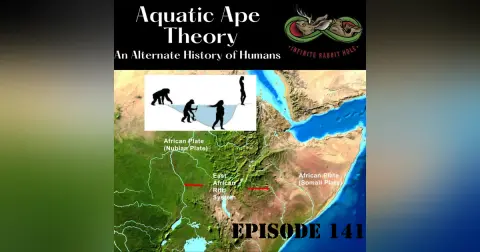
Anthropologists have gone back and forward for decades about the exact timeframe of human life on Earth. Gorillas, Chimps, Bonobos, Orangutans and Humans, all of which are referred to as the Greater Apes and out of our evolutionary cousins, we are vastly different. We look nothing alike. We act nothing alike. We are structured differently. With all of the differences we see between ourselves and our Ape cousins, we need to ask the question. What went so different for us? The other Apes evolved from those that moved with the shrinking forest, and we evolved from those that took to the plains. It was this that led Humans to develop bipedalism, hairless skin, toolmaking, increased intelligence, and verbal communications. Or so science believed. Long story short, this was proved false but we're not here to dissect this concept, instead we’re here to discuss a specific possibility of our history. One that mainstream science immediately denies under any and all circumstances. Today we dive into a theory that doesn’t place us into the vast plains or the Forests of Africa. But the borders in which land meets sea. Instead we dive deep into the most rejected possibility of them all. Today we look into the Aquatic Ape Theory!
And welcome back to Infinite Rabbit Hole.
0:43 Anthropologists have gone back and forth for decades about the exact time frame of human life on Earth. One of the more popular beliefs is that we originated in the forests of Africa, some eight or nine million years ago, the ancestor in which anthropologists believe that we evolved from is referred to as the last common ancestor or LCA for short. It is difficult to deal down exactly who this LCA was. But whoever it was, there are in most General sense. Five. Major branches of the evolutionary tree that sprouted from this individual gorillas chimps, bonobos orangutans, humans, all of which are referred to as the greater Apes out of our evolutionary cousins. We are vastly different.
1:28 We look nothing alike. We act nothing, like we're structured differently and we like to believe that we are in. Incredibly smarter that one I'll stay away from but the others we can address with all the differences we see between ourselves and our ape cousins. We need to ask the question. What went so different for us. The accepted scientific answer is something referred to as this Savannah hypothesis. Which evolved into what's referred to as the mosaic model in a nutshell. This states that our original home in the forests of Africa, became Barren due to climate change at the time and due to the receipt, Being of these Forest the incredibly size. Grassland ecosystem.
2:09 Now known as the African Savanna took over our place of residence, and we adjust The other Apes evolved from those that moved with the shrinking forest, and we evolved from those that took the planes. It was this that led humans to develop bipedalism hairless, skin tool-making, increase intelligence and verbal Communications or so science. Believed long story short, this was proved false mainly things to another ancestor of ours, the Australopithecus But we're not here to discuss why it was all wrong. No we're here to discuss a specific possibility of our history one. That means dream science, immediately denies under any and all circumstances.
2:54 With that being said, Travelers we dive into a theory that doesn't places into the vast plains or forests of Africa, but the borders in which land meets see we dive deep into the most rejected possibility of the mold. Today we look into the Aquatic ape Theory and we'll come back. To infinite rabbit. Welcome back to infinite.
3:41 Rathole everybody. I'm your host Jeremy and today did it go. Go deep into some crazy stuff. I'll tell you the research that I did for this particular subject, really blew my mind. There was a lie here and honestly when I first started it, there wasn't a lot that I really was banking on. I was like, you know, this is an interesting subject, but by the time I was done building this presentation, I can help it. There's so much here, there's so much that makes you think. And I hope that you guys get the same out of this. So, without further Ado, I present to you the infinite Rabbit Hole presents, aquatic ape Theory, Now, before I begin this presentation on the Aquatic ape Theory I would like to make one thing.
4:25 Clear, I'm not presenting this in a way to prove the existence of merfolk that is not what this theory is about. The meat of this Theory describes the two or three million years. We may have been water-bound somewhere along our evolutionary, life, span in comparison, whales or stations have a traceable evolutionary, life span of roughly 70 million years, as a solely water-based life-form, And seals as 25 million year span as mostly aquatic. No, one of the best comparisons of this theory is the otter. Alters our land-based mammals with some Aquatic Life Styles they eat, breathe mate, sleep!
5:05 Do a majority of their daily tasks outside of the water. The Aquatic ape Theory describes a time where early hominids would have been adapted to a life closely associated with water. If you look at just the skeletal structure of an otter would You are any scientist completely unfamiliar with this animal know that it had a lifestyle that relied so heavily on bodies of water. No, it's skeletal structure would look similar to Badgers weasels, minks, ferrets. And others of this shapely frame, it is no secret. We are a lot different from our ape cousins and the Aquatic ape Theory. Dives into that division. From the point of view, that we may have lived a more water Reliant lifestyle in the past.
5:48 Aquatic ape theory in 1942, a man by the name of Max Weston who offer brought up the idea that maybe we spent time living in Aquatic Life Style some time. In our history, the idea was more claimed as the only other quote, genius alternative, hypothesis by wesen Hoffer, but it was ignored and ridiculed by the majority of the scientific Community. Since then there have been a few that have come forward and defense of this idea, mostly notable sir Alistair Hardy in the 60s and presently laying more. Organ who unfortunately passed away. Just a few years ago, whose book, The Aquatic ape hypothesis to. I used heavily for the research of this presentation in a nutshell Morgan describes, the Aquatic ape Theory as quote, that the events, which diverted our own ancestors along, and unusual evolutionary path has something to do with water. Most of the evidence of this comes in the comparison of our anatomy to those of the other great apes which will do soon. But before we do that, let's look at geography and fossils from as far north Worth is the country of Jordan to as far south as the Southeast coast of Mozambique a, a distance that spans roughly 4,000 miles.
6:56 There is an area of Africa, known as the Great Rift Valley, this natural land full of deep massive Ravines basins and trenches was one of the few places on Earth that were home to Lush vegetation and gigantic Lakes during the last major ice age. This is where at least some of our ancestors called home today and in the history of anthropology this has been a gold mine of discovery about our past. Cast in a major majority of the fossils found of hominids were along the shores of these Great Lakes. Does that answer our question? Nope. Unfortunately, there are a few things to understand about fossils and life in general, if there is water, there's life, whether it is fresh water, or along the shores of the oceans, life is there.
7:37 We can expect that we were to another benefit of the coastline. Is the sediment that is commonly, found around body's water, and the sediment is an excellent Preserve. Of bones for fossilization due to the large amount of natural minerals. That when Harden over many years becomes something known as sedimentary. Rock the sedimentary rock, is what we find fossils in, and the study of this process is known as taphonomy. Think of it. This way, if something dies near the water, there is a chance that the body gets trapped in the sediment and is gone forever, unless dug up but if something dies in the grassland on the forest one or two things happens, they get eaten or they did. Okay, so unfortunately.
8:19 No, this does not like the theory and fact but it doesn't hurt the oldest discovered fossils of early hominids are found in the northern portions of the Great Rift Valley or Northeastern corner of the continent of Africa. The belief is that this is where the earliest hominins roughly 3.7 million years ago, began their evolutionary journey and through their time on the shores of the fast lakes that once were they would have become very reliant on the water as a source for food hydration mobility and Patient will awareness. But wouldn't you think that, if early hominid spent a considerable amount of time water-bound? Our legs would never have grown so long and our hands and feet would have begun adapting into webbed appendages.
9:01 Like you see in Doc's are flippers, like you see in seals and other Aquatic and sub aquatic creatures. Well, it is true that many Aquatic and semi aquatic creatures with legs, have very short Pantages, and it is very easy to see why the question would arise. But what about Orcs cranes and herons could we have gone down that path of evolutions for a long legs. If you look at the other Apes gorillas pans which are chimps and bonobos and poem goes more commonly known as a ranch hands, have short legs in comparison to rest their bodies. The Savannah Theory claims that we have longer legs due to having to run across vast areas of open Plains in order to stay alive. But what if it had, a more aquatic reason like that of her feathery, friends?
9:47 The The theory had its time in the Limelight for the majority of time. We spent researching the ancient African landscape but recently a new theory has risen this King that being the Mosaic Theory. The Mosaic theory is backed by many recent discoveries and more or less Common Sense. There was water in the area of the Great Rift Valley. 326 million years ago, this we know due to the number of fossils of Aquatic and sub aquatic species that have been found in these fast. Valleys the Mosaic theory states. That instead of being an area, Where there was nothing but wide open, Savannah. And then, all of a sudden there were these huge bodies of water. There were patches of forest along the water and stretched out and vague checkerboard like patterns that became more sparse as the forest began to give way into the Savannah.
10:34 This allows for our ape cousins to evolve side by side with us which answers the mystery of why. So many of their fossils were also found in the same areas that are less. Common ancestors were also found but it also takes away. The reason for science is favorite theory of why we lost our hairy bodies and grower long legs. If other Apes that live beside us, never changed in the same way. The question of why we did still applies bipedalism, it is no secret that the most glaring difference between us and the other great apes is that we consistently walk on two legs. Although our ape cousins can walk bipedally at times. Their favorite mode of locomotion is on all fours.
11:14 It was a concept. We brought up by the famed American zoologist of the early mid 1900s, William King Gregory that, by P lism in early. Hominids came naturally, after we left the trees and began to hunt it, allowed us to move fast more efficiently, but if it was such a great change in our physical structure, why wasn't it adopted by other mammalian creatures? The truth is that there are a lot more benefits to being quadrupedal than there is to being bipedal for one. All of your weight is distributed buta done for appendages. This allows for more efficiency in energy usage for a higher. Durance threshold allows the young to maneuver their bodies quicker after birth and allows for easier, birthing of young among the benefits. The most important besides energy cost is speed. I mean you ever try to raise your dog. Yeah you're probably going to win that race bipedal ISM. Also has some major flaws such as balancing on two feet, is incredibly hard to do.
12:15 Then on for and when attacked humans, typically fall to the ground. Vital organs are openly exposed more surface area. Exposed the weather, especially around, are temperature sensitive, organs harder to hide without giving up a quick means of escape and Agility is far less effective than knows on four legs. In fact, out of the few animals that have evolved to become bipedal, most of them become airborne such as birds and bats. The only other creatures to spend a decent amount of time on their hind legs are marsupials, such as kangaroos, but even they do not walk on two legs is their favorite mode of locomotion rather. It is primarily done in order to allow their young to remain in their pouch during movement.
13:01 Otherwise they walked around four legs. The young could just slip right out the majority of the time in a moving State, Kangaroos, and other marsupials will choose to use all fours. But what about apes and monkeys? A lot of us have seen videos Where other primates are walking on two legs. The truth is most primates are what we call break eaters brachiation is a form of locomotion using trees. This form of arboreal motion, is commonly seen as swinging, from limb to Limb and primate bodies are structurally built to maximize the use of this form of movement hips are splayed. Feet often are used as additional hands long arms and short legs are used for better balance in some species. The tail is used as a fifth appendage. Apes typically are what's referred to as semi break eaters, which makes sleeping and short periods of walking on two legs, while on a flat ground to their modes of motion. But even when they are on the ground and walking on two legs, their legs are bowed hips Sway, and elongated stripe patterns. And their arms are out to their sides is that they were walking a tightrope, their bodies are just not made for a permanent bipedal lifestyle.
14:09 So, if we look back to the aforementioned LCA or last common ancestor and we ponder about the different branches that it eventually evolved into why did gorillas and chimps evolve knuckle walking to a point that has been around for such a long time that the young are even born with pads used for this form of locomotion orangutans, of develop fist. Walking is seems that none of these Apes had developed a period of bipedalism at all. And why is it that throughout our fossil record? We have never found evidence that we as modern humans have ever doweled in quadrupedal ISM even though all of the Apes I As mentioned, including us at one point, came out of the trees and began moving along the ground floor of the forest. You would think that we all just in similar ways but that just didn't happen.
14:57 Why the Pains of walking, it is true that the human body is prone to lower back, pains hernias and even hemorrhoids and the cause of this is very well believed to be are perpendicular walking style. If we look back to a few things that I presented earlier. In particular speed and energy costs, we find that bipedalism hurts. Our chance of survival. In a wild setting, it makes a slow due to the use of half. The number of Limbs used to propel us forward and more air resistance from our upward posture and it uses a ton of energy. Both being critical to survival when you're trying not to become lunch to something. That is running all fours.
15:38 Into the water. Primates are the only animal that became strictly bipedal. When in weight above water picture, any quadrupedal mammal, other than a primate in the water. How are they moving? It is believed that primates do this in order to breathe because if they were to remain quadrupedal in the water, they would drown. But that would also be true for other four-legged mammals as well. The answer lies in the muscular and skeletal structures of primates and if one of Or to spend a reasonable amount of time in the water, say a few million years, how would it walk when it came out of the water? Now, keep in mind, I'm not talking about a strictly water-based life. I am referring to a primarily water based lifestyle.
16:21 You may have noticed that in the last segment, I failed to mention one of the most prominent great members, the bonobo, the bonobo aka the pygmy chimpanzee is a different case compared to the others primarily found in the countries. Are the bonobos environment is different from that of gorillas chimps and orangutans. Their environment is very prone to flooding and has historical evidence that the area was even wetter than it is today. But what about all of this is interesting? Well, although bonobos are considered to use all four appendages while in the trees, they are considered to be bipedal while on the ground. They also show uncharacteristic Comforts in the waters of the swamps around the trees that they live in.
17:03 They run plays swim and forage for food on Swamp floor. When they are not in the safety of the trees. He's with recent studies showing that chimps and bonobos began their separate evolutionary paths. Only 1.7 million years ago, could bonobos offer us a peek into what early life is humans. Look like all the bonobo does share one thing with us that other great apes do not long legs compared to all other known, great apes, bonobos and humans share legs, roughly proportional to each other. In comparison to the rest of their bodies, the bonobos closest living relative. The chimpanzee has short stubby legs. In the nude. Fun fact humans have more hair follicles per square inch on top of their heads. Then any other great ape in any part of their bodies, why was it to protect us from the Sun and spot of our bodies that directly faces the glowing source of skin cancer in the sky? Maybe.
17:55 But first, let's dive into another question. Why are we Newt modern scientists believe in a few reasons? Why this could have happened? Maybe it was evolutionary beneficial because it protected us, Us from harboring, an abundance of parasites. Or maybe it was just a way to cool us down. But how would we stay warm or maybe our lcas found one individual without hair and thought it was nice to look at and that individual fathered other hairless versions of itself and those Offspring became sought after but to understand naked Apes AKA humans, we might be fighting an uphill battle by looking at other Apes for reference, because there are none that we know of. So we may have better luck by looking outside The family and seeing what we have in common with others in the taxonomical class of mammalia. First, I would like to explain that we as humans are, what's referred to as audible morphic audible morphe is the term. Used to describe when a certain member of a family of animals stands out, for one reason or the other. The kicker here is that out of the morphe happens for a reason, polar bears, Arctic wolves, arctic, foxes, and ptarmigans are all white versions of their family trees. Why all of these use the color white to camouflage and snow environments.
19:12 All of them have a reason that they are the way they are and together. They create their own family of sorts based on the environment they live in. So what is the reason why we stand out? What is our family outside of the great apes? Well, here we are, looking at the water again. Almost all of the naked species of mammals in the world are at least semi-aquatic or have some history. As once being an animal reliant on a water based lifestyle. The only exceptions are the naked Somalian mole rat, which never willingly comes the surface and daylight certain pachyderms such as elephants, rhinos and pigs and well, us humans note. The term Pachyderm is no longer used. This once accepted taxonomic family has been segregated to better present its members.
20:00 Want to know the real funny thing about all the old pachyderms that live a life mostly away from water. They're all great swimmers. Yep. Pigs are good. Swimmers elephants are really good swimmers interesting huh. In addition to that elephants. Pigs. And biomes all spend considerable amount of time in water or covering themselves in mud in order to help themselves against the sun and the heat examples of the known naked. Mammals that live in aquatic or semi Aquatic Life, styles are hippos, walruses, manatees and dugongs. Yes. And the reason that these mammals are the way that they are is most likely that hair or fur does not insulate as well as it is supposed to. When it's wet, blubber and fat are thought to have been traded in due to being much better insulators in water. So let's see what our skin has in common with these fat water levers, one virtually naked skin. We talked about this already to our skin is much thicker than any other primates and that is on par with the other. Water-based naked mammals in comparison to their land dwelling, family, and three.
21:05 We have a considerably thicker layer of fat directly under our skin compared to our counterparts in the eighth family coincidences. Wow, let's look at that for a minute. There are two types of mammals that are known to have excessive amount of fat, build up, these being aquatic, mammals and hibernating mammals. And there is absolutely nothing. Our fossil record to make us think that our ancestors ever hibernated for the winter. R+ those that do Hibernia covered in fur, their fat does not adhere to their skin and their fatty tissue is a seasonal characteristic, not permanent. But another thing to look at, when it comes to fat, is our infants, human? Infants are incredibly fat when they are born compared to other apes and other. Mammals this growth of that continues until we are about a year old.
21:53 This is also a common phenomenon in one other group of mammals, you guessed. It aquatic mammals. Another comparison between Aquatic and Land Based mammals when it comes to fat, is the distribution of the fat. Mammals this spend their lives landlocked tend to have the majority of the fat in their bodies. Congregated around the major organs like the heart, liver and kidneys, whereas Aquatic and semi-aquatic mammals have the majority of their fat just under the dermis layer. Want to take a guess as to where the majority of our fat is in our body even with those that are in great shape. Honestly I think you know, Know where I'm going with this.
22:33 Water excretion. Did you know that the only mammal known to produce tears coming from their eyes, due to an emotional response other than a human is an elephant. Yes, it's true that many claim that horses and rhinos also produce tears during various emotional states. But neither has been proven to be caused by an emotion. Not something I'm using in this argument, but food for thought, for sure. Instead of looking at tears though, let's take a look at another form of moisture excretion from our bodies, sweat. Argument begins with one question. If humans, apparently evolved from an ancestor that spent its life In the Heat of the prehistoric African savanna. Then why are we so bad at retaining water?
23:13 Here's what I mean, a loss of 10% of the water in our body can be lethal for almost any human and extremely difficult to recover from. And we lose more water than any other mammal per pound of body weight with, almost everything we do in our daily life, sleeping crying, breathing urinating, defecating and sweating to name a few on top of a low drinking. King capacity, but almost every other mammal in the world comes up to 20% of its bodily moisture. It recover at a much more successful and quicker rate. Another thing to look at in the topic of water economy in our bodies is how come we are incredibly sweaty compared to any other mammal in the world. There are two primary parties when it comes to this question.
23:54 One is that we develop such a sliding mechanism to cools off in the heat, the sun-baked, grasslands, but then again, why would we do that? If we are so, To water loss and the other is that there is no way. We develop sweating due to a dry climate because it is counterproductive. If we sweat to keep cool but also dehydrate ourselves in the process without access to water and which the argument is yet again that because we did develop such a sweating mechanism. There must have been plenty of water rapidly available to feed the constantly deprived reservoirs and moisture in our bodies, which is an awesome argument for the idea that we did not develop due to To a dry Savanna. But rather a water-filled swampy Forest.
24:37 So how do other animals cool down? Their bodies on a hot day? The answer is panting panting has been adopted by most mammals as a way to regulate body temperature and is seen in our Arab cousins as well. It is also extremely efficient at dispersing heat, that enters the body from the surrounding environment. Yes, it is true that humans will pants when running or exercising but the reason we pant is not to controller. Temperature. But to allow for an increase oxygen usage per the demand of the activity. Yet another thing that separates us from, not just other mammals but the other great apes as well. All in all, when you really think about it, there must have been an incredible amount of time living in aquatic or semi Aquatic Life somewhere in human history, on the basis of fluid excretion alone, non panting animals, all live and Aquatic Life Style. There is no reason to pants and water with a thick layer of fat in The danger of drowning at the body naturally goes into such breathing technique, while underwater so far. We have discussed that.
25:39 We cannot have developed bipedal ISM. And the way that history tells us, we could not have developed fatty bodies in the way. History tells us, we cannot have developed new bodies in a way that history tells us and we could not have survived. If we develop sweating due to the way, history tells us, but an aquatic period in our history. Before we left the plains of Africa does work. Breathing in speech, another physical characteristic that separates humans from the other greater apes and almost. All other mammals is the development of a descended larynx. It has been long believed that this is why humans have developed speech but this has been proven to be false. But what is strange is that the only other mammals that are known to have descended? Lyrics' are dugongs walruses and sea lions. So why is it that we developed a larynx that lays lower in our Then almost all of our mammalian class members. It is a common misconception that if a human has developed it, then it is better than everything else that is wrong and it is wrong.
26:41 In this instance, a descended larynx is the root of why humans have higher rates of inhaling their own vomit. Consider a major factor in sudden, infant death syndrome and increases the chance of choking on your food, the lyrics, by the way, is what is commonly referred to as the voice box. And his job is to open to allow air into the lungs and close the block food from entering. Other mammals have larynxes that connect to the hard palate behind the roof of the mouth. This is a much better design and allows for much lower chances of choking on food and vomit getting into your trachea. Having a higher larynx also limits other animals to a primarily nostril breathing technique. Whereas humans are also primarily nasal breathers. But have the ability to change to predominantly oral breathing when wanted or needed?
27:28 So Again, why do we have a descendent larynx? If it is such a disadvantage. Well, let's look once again at the other animals that share the trait, the mammal world, the previously mentioned walruses, dugongs, and sea lions. All have the same basic setup that we do. And what do they do? That is vastly different than any others. They gulp are other Aquatic animals, do not gulp Air. Instead, they will simply hold their breath after a simple inhale. These mammals are also notably able to become mouth breathers when necessary like humans. And if we look outside the mail class and look at the avians, for example, birds that do not dive into water or knows breathers, only the birds that dive such as Ducks geese, the core markets have the ability to breathe their mouths, when needed.
28:19 But yet again, that has to be just another coincidence, right? Speech Elaine, Borg and put it best Quote, the doctor may ask you to breathe in or cough but he does not say things like well. Now I'd like you to slow down your heart beat or Kylie, sweat into this bottle for me and an ape is in the same position when asked to other speech, other great apes may want to or maybe ready to, but they lack the ability in their Anatomy to do so. And the muscles that they laugh are not in the mouth of throat, it's in their chest and allow the chest to expand and contract which pushes a control flow of air. Through the throat past the lyrics and out of the mouth producing a sound that we've referred to as a voice at varying ranges. So without these muscles speeches impossible for other Apes.
29:08 But why do we have these muscles? That allow us to blow out birthday cakes. Singing in the choir blow into breathalyzers or yell at the top of her lungs. And why don't our mammal family members have them? Well, there happens to be something referred to as the diving reflex or what is scientifically known as the bradycardia effect. This is the term given to the phenomenon in which all unwilling mammals one submerge into Waters at different temperatures than the surrounding. Air will unwillingly. Have their heartbeat, slowed and more oxygen sent to the brain. This effect can be seen in humans that have only their face submerged in cold water as well. And this physiological response allows for a longer time in which a mammal can hold their breath underwater compared to out of water. But the trick here is that typically the subject cannot know that.
29:58 They will be submerged into water and the Natural Instinct of the body in a situation where it does not know when it's next breath, will be causes the heart to slow down which uses less oxygen and most of the oxygen available in the body will be forced to the brain. In order to ensure that Consciousness is extended all leading to a longer period of holding breath. While underwater when studies were conducted in the 1960s and Beyond it was found that humans due to their ability of coping and their ability to control the rate of air entering and leaving the body. Were able to perform much better when compared to other mammals especially Apes. Humans are also able to create buoyancy in a way that other non aquatic animals.
30:38 Cannot we do this, not only because of the fat layer attached to our skin, but also because of our ability to gulp an air, and the muscles that are needed in order to keep it there. Now, before we finish up with breathing and speech want to point out, one more observation that was made in Lane Morgan's book. The Aquatic ape hypothesis. That being that apes are well known. To have adapted visual signaling in order to communicate, it has even been proven that various species contain the ability to learn sign language as a way to directly communicate with humans. But in the wild their visual language looks more like a waving of the arms jumping kicking and in some cases clapping all meaning various things, depending on where you are, studying the animals but make no mistake about it.
31:23 They do communicate. So why did we not go down a similar path? Why do we use our voice instead? Well, Elaine Morgan's argument is that if we were mostly submerged in water, or at least spent a really good portion of time in water, then visual signals would have been useless another individual inside or outside. The water would not be able to see what you were trying to say to them. If you are up to your neck in water, and the question that remains unanswered bibs and we develop speech as a way to communicate. you to our environment, which may have been a bit wetter than we are told that was Other head scratchers. Before we sign off, on this subject, there are a few smaller points to make.
32:07 So in this section of the presentation, I'll dive into a few other aspects of the Aquatic ape theory that do not fit into the sections. I previously covered. And the first thing that we need to go over is sex. There are only three land. Mammals in the world that have been proven to have sex in a face-to-face position. Humans are the most prevalent and will typically do this as the most common sexual position for the species but gorillas orangutans. The bonobos have been witnessed doing so as well. Bonobos choose the missionary position about half of the time where orangutans and gorillas choose it very infrequently. Up until recently, it was believed that only humans had sex in such a fashion. But where else in the animal kingdom is this practice?
32:48 Seen, you guessed it, an aquatic and semi aquatic species, whales dolphins, and even beavers all typically have sex in a face-to-face position. But how about the menstrual cycle of the human female? Or any coincidence that the typical cycle last 29, and a half days, which is exactly the same length of the lunar cycle. There are no known land. Mammals that follow any lunar cycles for any part of their biological day, but there are plenty of ocean species that are synced with the lunar cycle in regard to the biological activities which are much more important than on land. Due to the tides being directly related to the lunar phases. One of the most intriguing physical features of the human body when it comes to the Aquatic ape Theory.
33:31 Yuri is the nose, the closest thing to the human nose and nature is that of the proboscis monkey and science has its theories. As to why that knows developed the way it did. Our nose is on the other hand, differ from all of the others because of a structured, attach the skull referred to, as the nasal spine. This is the little point of the skull that protrudes out to a point just above the upper lip and below the nasal cavity. Honestly, I didn't even know this existed but it is due to this little feature that are no. Is not just as Flappy as an elephant's trunk. The nose drops down from an area between the eyes and continues away from the skull following cartilage. This is why the nose is movable to an extent with the nasal spine, under the bottom of the nose. These internal structures create downward pointed nose, that looks nothing like anything in the Animal World primates, typically have two holes above their lips that are not protruding from the facial structure. Our nasal structure comes in handy in one situation, diving into water The Apes have a notoriously bad time in water, due to water easily entering the nasal passageways, but this is not the case for humans.
34:39 Once learned how to swim without getting water in your nose. This becomes incredibly easy and more or less a habit instead of consciously stress activity, but the mysteries of the nose don't end there. Now let's look at the part of the upper lip known as the philtrum which is the vertical Groove between the base of the nose and the border of the upper lip for one. No other primate has developed if her lips like that of a human many humans, without a mustache can push their lips into their nostrils with their fingers before submerging themselves in the water. This of course, takes some practice, but once mastered the lips stay in place perfectly. Stop any water from entering the nostrils. Of course, this was probably more predominant before we begin to adapt to life outside of the water. But if you look at the formation of the upper lip, the philtrum does match the tissue structure between nostrils and the fattiest parts are lips are directly. The holes in your nose.
35:32 I thought that this was very interesting and I had to test it with my kids, it worked, but the lives easily fell away with any twitch of the facial muscles or Too Fast Change in Direction. Anyways, I know this was a pretty quick one on a very, very dense subject. But all in all the research into this topic has really increased my interest into a subject that honestly didn't, hold much weight for me, but the arguments put forward by the authors of the books and articles, I read through our church, Truly eye-opening. The fact of the matter is that we came from somewhere, our history is a thing, but did we come from the dry? Arid? Savannah, the prehistoric East Africa. I personally no longer believe that is the case. There are just too many things that do not connect from anyone. Why did the adoptions that our biology made not happen in others that share the same space with us? There is an incredible amount of material on the subject and if there is enough to man, I believe that I can extend this presentation to a second.
36:31 Now, so sometime down the road. So please, if you did enjoy this and want to know more reach out, let me know. And until next time travelers, I'll see you the next path of the infinite Ravenel. Bye. I would like to thank you once again for tuning into the infinite Rabbit Hole podcast, please. Make sure to give us a follow and one of those beautiful five-star ratings on your podcast player of choice. If you would like to join the conversation and stay up to date, on all things into the rabbit hole head on over to Facebook and search for the infinite Rabbit Hole Facebook. You all know it's us from see the logo.
37:13 If you would like to help contribute to the cause there are a few ways to do. So, first head on over to Anchor dot f, m-- forward, slash infant rabbit hole, and click on the Subscribe button where for five dollars a month, you'll get access to all our old episodes, that will never see the free Spotlight ever again. It's horrible stuff. If you're into that kind of thing, and go check that Second head on over to into the rabbit hole.com and click on the irh merch shop Tab and grab yourself, a sweet t-shirt sticker or whatever else. You see that you were mine own, until next time, travelers, I'm Jeremy. And I'll see you at the next fork in the path of the infinite rabbit hole.